Abbe Faria
Abbe Faria, the learned Italian priest imprisoned at the Chateau d'If, is the catalyst who transforms Edmond Dantes from a desperate, uneducated sailor into the Count of Monte Cristo. Imprisoned since 1811 for his political dream of a unified Italy, Faria is known to the prison authorities as a harmless madman obsessed with a hidden treasure. Yet within his dungeon, he has created a universe of knowledge: he speaks five modern languages and ancient Greek, has memorized one hundred and fifty key volumes, and has written a treatise on Italian monarchy on strips of cloth using ink made from soot and wine. His meeting with Dantes, who has been digging toward freedom, redirects the young man's escape into an education that will remake his entire being.
Identity and Imprisonment
Faria is a man of small stature, with hair whitened by suffering rather than age, a deep-set penetrating eye, and a long black beard reaching to his breast. His thin, deeply furrowed face and bold features betoken a man accustomed to exercising his mental faculties rather than his physical strength. He was born at Rome, served for twenty years as Cardinal Spada's secretary, and was arrested toward the beginning of 1811 at Piombino, ignorant of the reason for his detention. His crime was political: in 1807 he dreamed of the plan Napoleon tried to realize in 1811 — to alter the political face of Italy by forming one large, compact, and powerful empire instead of a collection of petty principalities. He fancied he had found his Caesar Borgia in a crowned simpleton who feigned to enter into his views only to betray him. For this, he was first confined for three years in the fortress of Fenestrelle, then transferred to the Chateau d'If in 1811. The prison authorities consider him mad because he persistently offers vast sums for his release, speaking of a treasure of five millions. In reality, his madness is the sanity of a man who knows a secret that no one will believe.
Life in the Dungeon and Meeting with Dantes
Faria has spent years in solitary confinement, but his cell is a workshop of civilization. He has made tools from bed clamps — a chisel, pincers, and a lever — and has used them to dig a passage fifty feet long toward what he believed was the outer wall, only to discover that he has instead reached the corridor outside Dantes' cell. When Dantes, having resolved to starve himself to death, hears the scratching of Faria's excavation, he responds with three knocks, and the two prisoners begin their extraordinary communication. Faria initially hesitates to trust the young man, but Dantes' age — not quite twenty-six — reassures him that he cannot be a traitor. When Faria finally emerges through the floor of Dantes' cell, the young man seizes him in his arms and carries him toward the window to see his features by the imperfect light. Faria receives the enthusiastic greeting with evident pleasure, as though his chilled affections are rekindled by contact with one so warm and ardent.
Intellectual Mentorship and Education of Dantes
Faria becomes Dantes' teacher in every branch of knowledge. He possesses a prodigious memory and an astonishing quickness of conception; the mathematical turn of his mind renders him apt at all kinds of calculation, while his naturally poetical feelings throw a light and pleasing veil over the dry reality of arithmetic. Dantes already knows Italian and has picked up some Romaic during voyages to the East; by the aid of these two languages he easily comprehends the construction of all the others, so that at the end of six months he begins to speak Spanish, English, and German. Faria teaches him mathematics, physics, history, and the three or four modern languages he knows, promising that in two years Dantes will know as much as he does himself. The abbe's conversation contains useful and important hints as well as sound information, and it is never egotistical — the unfortunate man never alludes to his own sorrows. Dantes listens with admiring attention, and some of Faria's remarks open new vistas to the inquiring mind of the listener, giving fantastic glimpses of new horizons. At the end of a year, Dantes is a new man.
Revelation of the Treasure and the Will
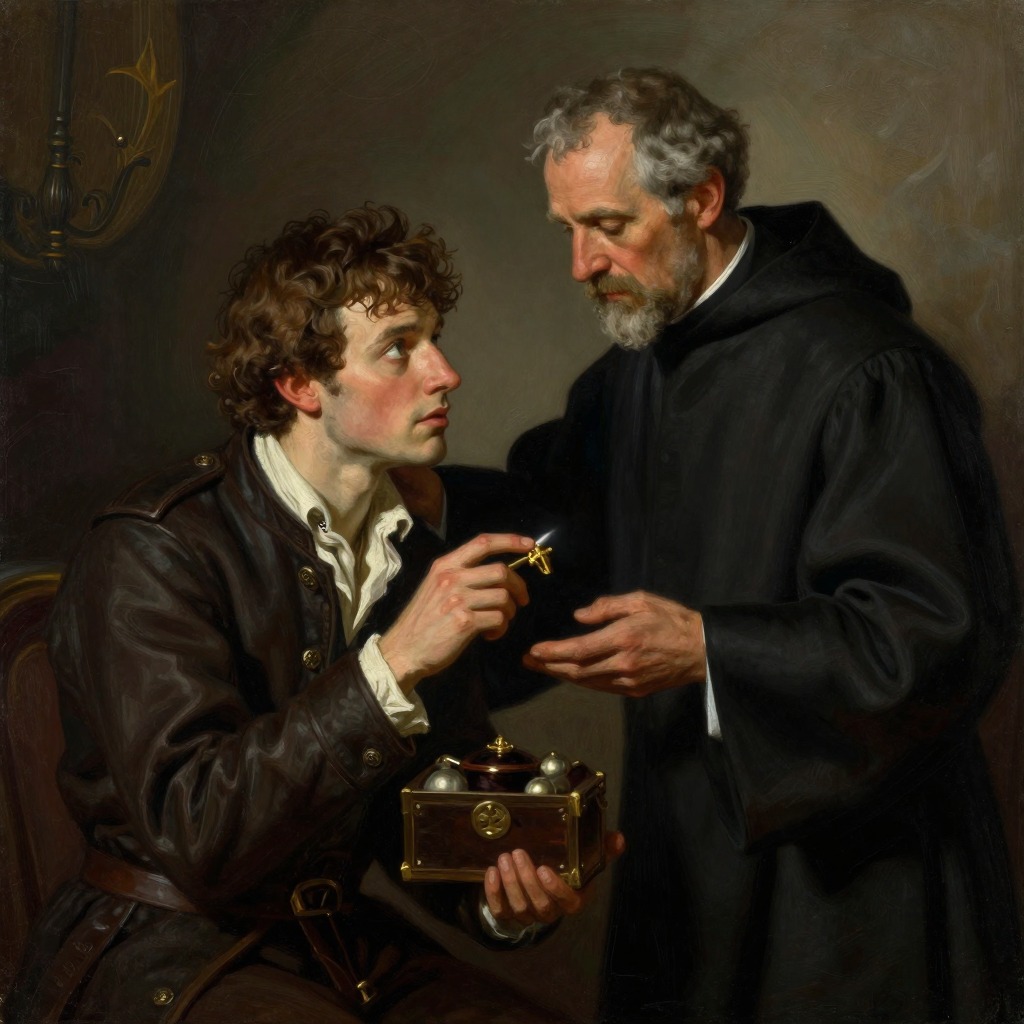
Faria reveals to Dantes the secret of the Spada treasure, which he has discovered through a half-burned paper found in the breviary of Cardinal Spada, whose secretary he was. The paper, when exposed to fire, revealed characters written in sympathetic ink, describing a treasure of nearly two million Roman crowns hidden in the caves of the small Island of Monte Cristo. Faria has reconstructed the complete meaning of the document through years of study. He declares Dantes his son and sole heir, saying, "You are the child of my captivity. My profession condemns me to celibacy. God has sent you to me to console, at one and the same time, the man who could not be a father, and the prisoner who could not get free." Dantes learns the letter by heart from the first to the last word, and Faria destroys the second portion of the document, assured that if the first were seized, no one would be able to discover its real meaning.
Illness, Death, and Legacy
Faria suffers from a hereditary malady of catalepsy, which he knows will eventually kill him. During his first attack in Dantes' presence, the young man administers the remedy — a red liquid from a phial hidden in the bedpost — and saves his life. But the attack leaves him paralyzed in his right arm and left leg. He tells Dantes, "None can fly from a dungeon who cannot walk," and urges the young man to escape without him. Dantes swears by the blood of Christ never to leave him while he lives. Faria's third and final attack comes when he is already weakened; Dantes administers the remedy, but this time it fails. The old man dies, murmuring, "Monte Cristo, forget not Monte Cristo!" After his death, the prison authorities burn his heel with hot irons to confirm his death, then sew his body into a sack and throw it into the sea with a thirty-six-pound cannonball tied to his feet. Dantes takes the place of the corpse in the sack, and is thrown into the sea himself, thus escaping the prison. Faria's legacy is twofold: the intellectual and moral transformation of Dantes, and the treasure that makes possible the Count of Monte Cristo's vengeance and reward.
Thematic Significance
Faria embodies the power of knowledge and the human spirit to transcend even the most extreme confinement. He is the mentor who gives Dantes not only the means of escape but the very identity of the Count of Monte Cristo. His philosophical maxims — "To learn is not to know; there are the learners and the learned. Memory makes the one, philosophy the other" — and his belief that "misfortune is needed to bring to light the treasures of the human intellect" shape Dantes' entire worldview. Faria also represents the limits of pure intellect when confronted with the irrationality of the world; his political dream of a unified Italy failed, and his treasure was dismissed as madness. Yet in death, he achieves more than he could in life: his knowledge lives on in Dantes, and his treasure becomes the engine of a justice that transcends human law. The abbe's final words to Dantes — "Wait and hope" — become the novel's closing message, spoken by the count himself to Maximilian and Valentine.